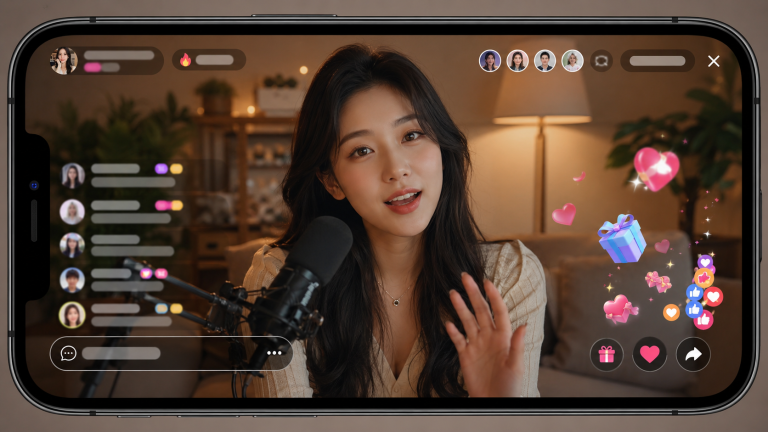
The First 90 Seconds of a Live Streaming App Launch
Most new live streaming apps do not lose a creator because the video stack is terrible. They lose the creator before the room has even had a fair chance. A host opens the app, checks the preview, sees an empty room, waits through a slightly awkward silence, and decides the platform feels dead. That judgment is often made in the first 90 seconds.
It is tempting to treat this as a marketing problem: buy more traffic, recruit more hosts, send more push notifications. Those things matter, but they do not repair a bad first-room experience. The real work is operational. Someone needs to decide who is present at launch, what happens when the first guest arrives, how gifts are introduced without feeling forced, and what the support team sees when a host gets stuck. A buyer evaluating a bigo live clone source code package should inspect that sequence as carefully as the home feed.
The empty-room moment is not a small UX detail
Picture a new host, Maya, scheduled to go live at 8:00 p.m. She has been told to broadcast for 30 minutes and has prepared a simple introduction. At 7:59, the camera permission prompt appears again because she switched devices. At 8:01, she starts the room. The room title is generic, her welcome message is blank, and nobody arrives for the first two minutes.
Nothing has technically failed. The stream is live. The dashboard will count a session. Yet the host has already learned the wrong lesson: going live here is lonely and confusing.
That is why the first 90 seconds deserve a deliberate operating design. It is the short stretch where product behavior, host coaching, notifications, moderation, and community supply meet in one visible moment. If any piece is late, the host feels it immediately. A polished gift animation cannot rescue an empty room. Nor can a large creator program rescue a launch flow that leaves a new host guessing which button to press.
Design a launch sequence that a real operator can run
The useful question is not “does the app support live video?” Nearly every demo says yes. Ask instead: “What does our operator do from five minutes before a first stream until the first meaningful interaction?” The answer should fit on one page and be clear enough for a new community manager to follow.
A practical first-stream sequence usually looks like this:
- Five minutes before: confirm the host is online, check camera and microphone permissions, and place a short room title or topic prompt in advance.
- At launch: assign one trained greeter or agency teammate to enter early, say something specific, and verify that chat and audio are working from the viewer side.
- Within the first minute: trigger a small, honest reason for a second person to join: a scheduled topic, a welcome challenge, or a compact co-host introduction.
- After the first interaction: let the host lead. The operator should not keep filling the chat with scripted praise. That turns a quiet room into an obviously staged room.
The details vary by market and content type. A music host needs a different opening from a relationship talk room. But the sequence itself should exist. It turns an emotional gamble into a repeatable process, and it makes it possible to see where a first session breaks down.
Give hosts a small amount of structure, not a script
New hosts often freeze because they are trying to create momentum and operate unfamiliar controls at the same time. They need guardrails: a prefilled room-topic option, a visible connection status, a clear guest-request queue, and a simple way to pin one prompt. They do not need a two-page script that makes every room sound the same.
One team can prepare three opening prompts for each content lane. A casual chat host might choose “What are you cooking tonight?” A gaming host might start with “Pick my first challenge.” A local-language host can use a prompt that reflects the actual audience rather than a translated global slogan. The host chooses one, changes it, or ignores it. The point is to remove the blank-screen moment without turning the product into a call center.
The same restraint applies to onboarding. Do not make a new creator configure every possible setting before the first broadcast. Required checks are camera, microphone, account status, and a basic room label. Advanced features such as game overlays, multi-guest layouts, paid rooms, and agency tools can appear later, when the host has already seen a room work. Asking for all of it upfront is a reliable way to produce abandoned drafts.
Seed early interaction without manufacturing fake activity
There is a line between helping a new room get started and creating the illusion of an audience. Crossing it creates a bigger problem than the one it solves. Hosts eventually notice patterns. Viewers do too. Trust is hard to rebuild once people suspect the platform is padding room counts or using automated chat to pretend a community exists.
Use real people with a real purpose. Agency leads can support their own recruits. Community staff can greet hosts and report launch problems. Existing creators can be rewarded for co-hosting a newcomer for ten minutes. These participants should be identifiable in internal records, and their role should be reviewed like any other operational cost.
What matters is the quality of the first exchange, not an inflated number in the viewer counter. One person asking a genuine question gives the host something to answer. A co-host request gives them a decision to make. A modest welcome gift from a real supporter shows the economy without pressuring everyone else to spend. Those are events a host can build on.
Make the control room useful during a live session
Many buyers see an admin dashboard and stop their review there. The better test is to run a live launch while someone watches the dashboard. Can the operator tell that the host is live? Can they see whether the stream is reconnecting? Can they identify a blocked chat message, a failed gift payment, or a guest who cannot enter? Can they reach the host without making them end the room?
A good control room does not need twenty charts. It needs the few signals that change an operator’s next action:
- room state, elapsed time, and recent reconnects;
- viewer joins and exits in a short time window, not just a lifetime total;
- chat or guest-request failures that need intervention;
- payment and gift events with a visible failure state;
- a clear moderation trail when an account or message is restricted.
This is also where buyers should ask uncomfortable questions. What happens if a payment callback is delayed? What happens if a moderator removes the wrong user? What happens if the host drops from Wi-Fi to mobile data halfway through a co-host session? A vendor does not need to promise that none of these things happen. They need to show the actual state transitions, logs, and recovery behavior. The complete solution overview is useful for checking the wider platform scope, but the launch test exposes whether the operations layer is usable under pressure.
Measure the handoff, not just the broadcast
“Number of streams started” is easy to count and easy to misread. A better early metric is whether a new host reaches a meaningful handoff: their first real chat exchange, their first guest interaction, their first scheduled return, or their first verified gift. The right event depends on the business model, but it should be an event that signals the room moved from setup into participation.
For an early-stage platform, track a small funnel for each cohort: approved host, completed setup, started first room, received a real interaction, returned for a second room. Then review failed sessions with a human being, not only a spreadsheet. Ten short notes such as “could not hear guest,” “did not know where to set title,” or “greeter arrived late” will often tell you more than a month of vanity metrics.
There is a useful discipline here: do not blame the host until the launch path has been observed. When a creator leaves after one session, teams often label them uncommitted. Sometimes that is true. Sometimes the room opened with broken audio, no context, and no visible support. Those are very different problems, and only one is solved by recruiting another host.
Run a buyer acceptance test before you sign
If you are buying or white-labeling a live streaming platform, ask for a first-room test in a staging environment and then repeat it on a real device over ordinary mobile data. Do not accept a polished screen recording as evidence. Use two devices and at least two accounts. Start a room, join it, send a chat message, request to join as a guest, send a small test gift if payments are enabled, and deliberately interrupt the network for a few seconds.
Write down what you see. Was the host told that the guest joined? Did chat catch up after reconnecting? Did the operator have enough information to distinguish a network problem from a moderation action? Did the transaction have a clear final state? A platform can have a long feature list and still fail this basic rehearsal.
This test is not about catching a vendor out. It is how both sides expose the work needed before a public launch. Some issues will be configuration. Some will be training. Some will require engineering. The useful vendor is the one who can separate those categories and give a credible next step for each.
FAQ
Should every new host receive guaranteed viewers?
No. Guaranteeing a number creates the wrong promise and can push a team toward fake engagement. Give new hosts a reliable launch process, real support, and a clear first interaction path. Audience growth still has to be earned.
When should a platform introduce gifts?
Show gifting when the host has enough context to use it naturally. A small real welcome gift or a simple explanation from a greeter can work. Pushing gifts before the room has a conversation usually feels transactional and awkward.
Is this only relevant for video live streaming?
No. Voice rooms have the same cold-start problem, just with different controls. The equivalent checks are audio route, seat requests, speaker order, moderation, and a first conversation prompt.
What should we fix first if new hosts do not return?
Review a handful of first sessions end to end. Start with setup friction, audio/video reliability, and whether anyone was assigned to greet the host. Do not jump straight to broad acquisition spend.
Start with one dependable room
A live streaming app becomes believable when a new host can open a room, find their footing, and leave with a reason to return. That is a smaller goal than “build a community,” but it is the part community growth rests on. Get the first 90 seconds right, document the handoff, and improve it one failed session at a time.
For a walkthrough of the launch flow, admin tools, and the buyer checks that matter before rollout, message us on WhatsApp or email the team. A focused demo is more useful than another generic feature list.