Bigo Live Clone Socket Event Ordering for Live Rooms
A Bigo Live clone can look stable in a demo while its room events are already fragile. One host starts a room, three viewers join, one gift is sent, chat moves, the viewer count rises, and everything feels fine. Then the same room meets real traffic: weak Android phones, reconnecting viewers, gift bursts, host network switches, delayed wallet responses, and admin actions arriving while the room is still active. The problem is not always the RTC stream. A lot of ugly bugs come from event ordering.
Event ordering is the quiet engineering layer behind a live room. It decides whether a gift animation appears after the wallet confirms, whether a muted user can speak again after reconnect, whether a room-close event beats a late chat message, and whether admin can explain what happened. If you are reviewing bigo live clone source code, do not only inspect UI screens. Ask how room events are sequenced, stored, retried, and audited.

The Room Has More Than One Timeline
A live room usually has several timelines running at the same time. RTC has its own join and media state. Socket has messages and room events. Backend has room records, gift transactions, moderation actions, and wallet ledger. The app UI has local optimistic states. These timelines do not always move together.
That is where bugs start. The viewer sends a gift, the app shows loading, the wallet service confirms, the socket broadcasts the gift, and the host income service writes a record. If the socket message arrives before the wallet response on another client, the room may show a gift that is not financially confirmed. If the host closes the room while that gift is processing, settlement may become unclear.
A serious implementation needs a room event model. It does not need to be fancy. It needs to make ordering visible.
room_event:
  event_id: evt_20260716_000391
  room_id: live_77201
  seq: 1842
  type: gift_confirmed
  actor_id: u_1930
  target_id: host_8821
  related_tx: tx_gift_92013
  created_at_ms: 1784184920123
  server_node: socket-a03
The important field here is not the exact name. It is the sequence. Every client should be able to understand that event 1842 happens after 1841 and before 1843. Without that, reconnect recovery becomes guesswork.
Do Not Let The Client Become The Source Of Truth
Client-side optimism is useful. A viewer taps a gift, the button should feel responsive. A host mutes a noisy guest, the UI should change quickly. But the client should not be the final authority for money, room role, mic state, or moderation state.
In weak projects, the client sends a socket message and other clients trust it too much. That works in a friendly demo. In production, it creates race conditions and abuse risk. A gift should come from a server-confirmed transaction. A mute should come from host permission verified by backend. A room close should invalidate later room actions.
- Client sends intent: user wants to send gift, request mic, mute user, close room.
- Backend checks permission, balance, room state, and risk flags.
- Backend writes durable record if needed.
- Socket broadcasts confirmed event with sequence number.
- Clients render according to confirmed event stream.
This model is slower than blind client broadcast by a few milliseconds. It is also much easier to debug when money or moderation is involved.
Reconnect Is The Real Test
Most live room demos test a clean join. Reconnect tests expose architecture. A viewer loses network for 15 seconds and returns. What should the app do? It needs current room state, missed events, viewer role, wallet state for pending gifts, mic state if voice/video connection exists, and whether the room is still open.
A practical reconnect flow should not simply re-enter the room and hope socket catches up. The client should ask for a room snapshot and the last known event sequence. The server can then return missing events or a fresh state if the gap is too large.
reconnect_request:
  room_id: live_77201
  user_id: u_1930
  last_seen_seq: 1811

reconnect_response:
  current_seq: 1848
  room_status: live
  host_online: true
  missed_events: [1812, 1813, 1814, ...]
  fallback_snapshot: null
If the missed event list is too long, the server can send a snapshot instead: current room status, host status, viewer count, latest gift banner, muted users, blocked users, and active admin flags. This avoids replaying thousands of events after a long disconnect.
Gift Events Need Two-Phase Thinking
Gifts are where room atmosphere and finance meet. The user expects instant feedback. Finance needs exact records. Hosts care about income. Admin needs audit trail. Treating a gift as one simple socket message is not enough.
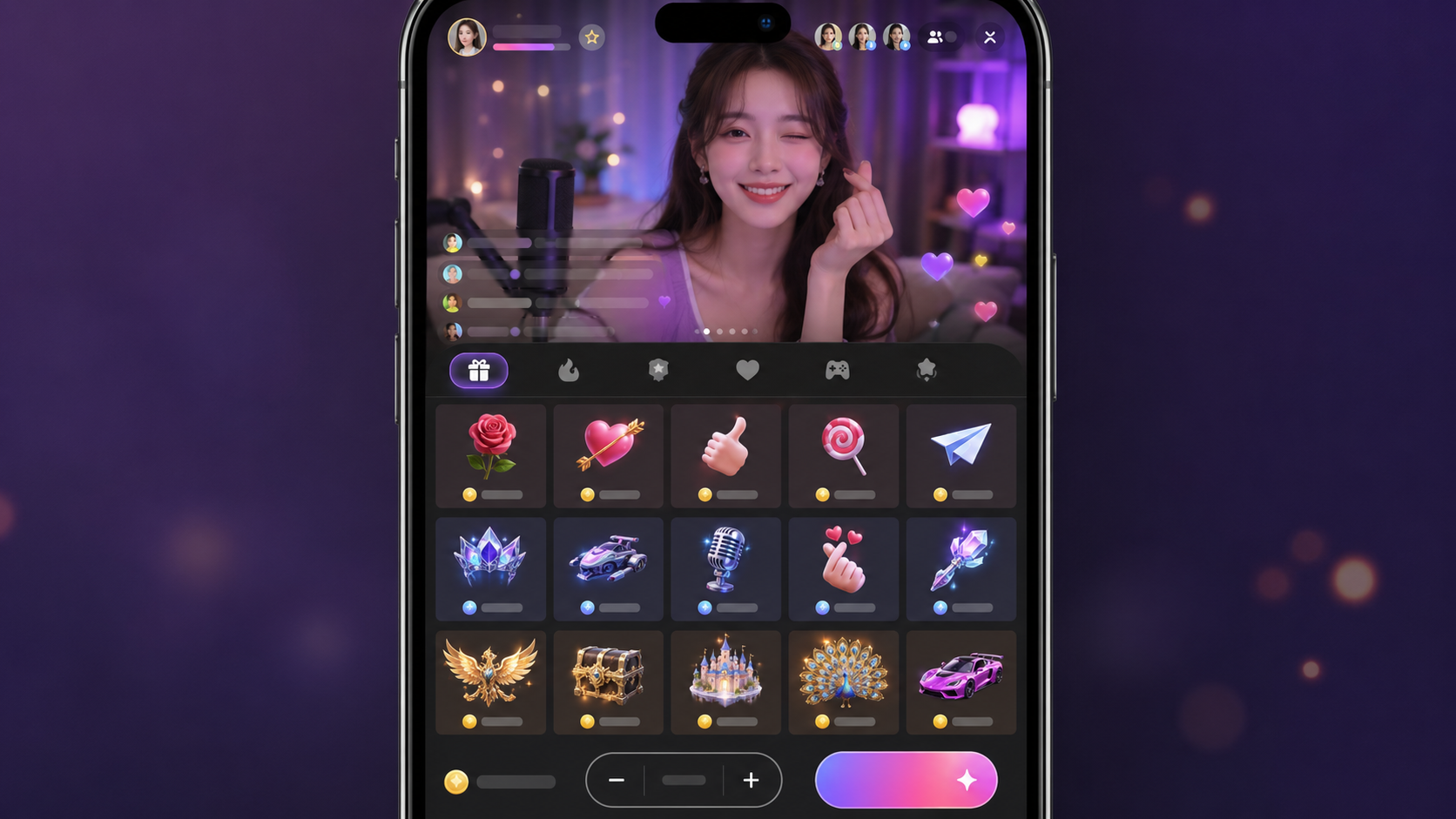
A safer gift flow has two phases. First, the client sends an intent to spend coins. Second, the server confirms or rejects it. Only the confirmed event should be broadcast as a real gift. The UI can show a small pending state locally, but it should not trigger room-wide animation before the transaction is accepted.
gift_intent: client asks to send gift.wallet_lock: backend checks and reserves balance.gift_transaction: durable gift transaction is created.gift_confirmed: socket broadcasts room event.host_income_pending: settlement record is created.
This also helps anti-fraud work. If one device sends gifts too fast, the backend can throttle intents before room-wide effects are triggered.
Admin Actions Should Beat Late User Actions
Admin and moderation events need priority. If admin closes a room at sequence 1900, a late chat message or gift intent from sequence 1899 should not create a visible event after the room is closed. The backend should reject or mark it based on room state at processing time.
This is one reason server-side ordering matters. The app cannot rely on arrival order over network. A user action sent earlier can arrive later. A moderation action should define a boundary: after close, no new room activity should be accepted except exit, settlement cleanup, and logs.
moderation_boundary:
  room_id: live_77201
  close_event_seq: 1900
  close_reason: policy_violation
  blocked_after_seq: 1900
  allowed_after_close:
    - user_exit
    - settlement_finalize
    - support_log
What Buyers Should Ask During Code Review
You do not need to read every socket file. Focus on the failure points. Ask the seller to show the flow from API request to socket broadcast to admin log.
- Where is the room event sequence generated?
- Can reconnect recover missed events?
- Are gift broadcasts server-confirmed or client-trusted?
- What happens when room closes during gift processing?
- Can admin search room events by room ID, user ID, event type, or transaction ID?
- Are event logs kept long enough for support disputes?
If the answer is “we can check server logs,” that is not enough. Support should not depend on raw logs for normal disputes. A useful admin panel should expose the important event trail.
FAQ
Is socket event ordering only a backend issue?
No. Backend should define the order, but clients need to render events safely, ignore stale events, recover after reconnect, and avoid trusting local optimistic state too much.
Does every room event need to be stored forever?
No. Chat messages and lightweight presence events can expire faster. Money, moderation, room close, gift, wallet, and settlement-related events should be kept long enough for support and finance review.
What is the biggest red flag in a live room socket design?
Client-trusted money or moderation events. If the client can broadcast a gift or role change without server confirmation, the product may work in demo but become risky in production.
Where does this fit in a larger source-code review?
Event ordering belongs beside wallet, admin, and delivery checks. For a broader page set, start with the Bigo Live Clone Pages collection.
Need a technical review of live room source code?
If you are reviewing a Bigo-style live streaming source code package, I can help check socket events, room lifecycle, wallet confirmation, gift broadcasts, reconnect behavior, and admin traceability.
WhatsApp: +44 7999 529473
Mail: [email protected]