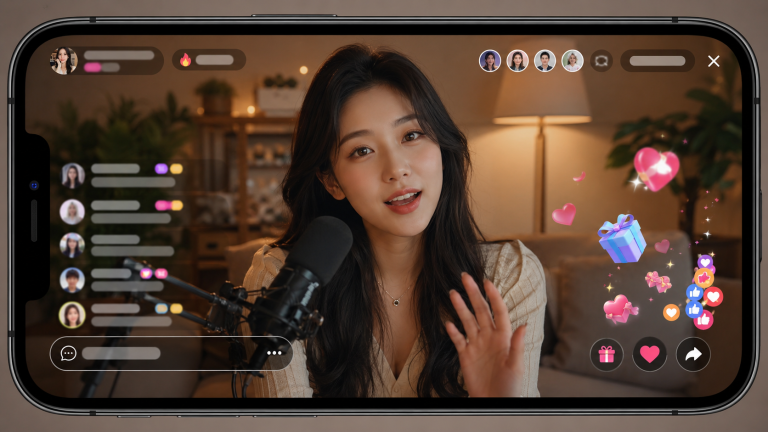
Poppo Live Clone Source Code for Voice Rooms and Gifts
Searching for a Poppo Live clone usually starts with a screenshot. Someone points at a busy room, a gift animation, a seat layout, and a coin balance, then asks for “an app like this.” That is a reasonable starting point, but it is not enough to buy or build a usable product. A social live app is not one screen. It is a chain of permissions, room states, wallets, moderation decisions, creator tools, and support workflows that have to agree with each other when real people are spending time and money.
That is why the useful buyer question is not whether a vendor can reproduce the surface. It is whether the delivered source code supports the behavior behind it: a host opening a room, a viewer taking a seat, a guest being approved, a gift being paid for, a moderator removing abuse, and an agency following up with the creator afterwards. Those moments are where a project becomes an operating product instead of a demo.
What buyers usually mean by a Poppo Live clone
The phrase covers several different requirements. Some buyers want a voice room app with seats, host controls, and a simple gift economy. Others want a video-first social live streaming app. Some need an agency system because they already work with recruiters or creator managers. Others care most about a wallet, regional payment flow, and an admin panel that can settle disputes without asking an engineer to inspect the database.
Put those requirements in writing before comparing proposals. Otherwise, the conversation gets trapped at the feature-list level. Two vendors can both say “multi-guest room” while one means a basic microphone queue and the other means a production-ready set of roles, invitation rules, reconnect handling, and moderation controls. The label is the same. The operational cost is not.
A practical scope normally separates four layers:
- Audience experience: discovery, room entry, chat, seats, follows, notifications, and replay or history rules.
- Host experience: start flow, co-host requests, room controls, audience management, earnings visibility, and support contact.
- Commercial layer: coins, virtual gifts, recharge, withdrawal rules, promotional events, and payment reconciliation.
- Operations layer: admin roles, content review, agency management, risk controls, dispute records, and reporting.
If a proposal only describes the first layer, it is describing a consumer interface, not the whole platform. The broader live streaming source code overview is a useful reference point when you need to compare that platform scope across product styles.
Voice rooms are a workflow, not a grid of profile photos
Voice room layouts look simple because the important work is hidden. A host sees open seats, speaker icons, and a chat feed. Behind that, the product needs to know who owns the room, who can invite someone up, whether a listener has requested a seat, whether a muted speaker is intentionally muted, and what should happen when a network reconnection changes the order of events.
Ask a vendor to demonstrate a busy room with two devices, not just explain it. Have one listener request a seat, have the host approve it, let the guest disconnect for a moment, and then try to remove a disruptive user. Watch what each person sees. Is the guest’s request still visible after a reconnect? Does the host get a useful state change or just a silent failure? Can a moderator act without ending the room? Small gaps here create most of the “our room feels unreliable” reports later on.
This matters even more for an app that supports both voice and video rooms. The product needs a clear rule for what is shared across modes and what is not. A wallet may be shared. A moderation history may be shared. Room controls, bandwidth expectations, seat behavior, and camera permissions should not be treated as identical merely because they happen under the same brand.
Virtual gifts need a complete money path
Gift animations are easy to show in a sales call. The harder part is the money path around them. A buyer should be able to trace one small test purchase from recharge to wallet balance, from wallet balance to gift send, from gift receipt to host earnings, and from earnings to the rule that makes withdrawal possible. If that path is not clear, no amount of visual polish will make the commercial side trustworthy.
There are a few questions worth asking directly:
- What is the final state when a payment succeeds on the provider side but the app has not yet updated the wallet?
- Can an operator see the purchase, gift, and withdrawal records together when a user disputes a transaction?
- Which actions are reversible, and who can approve a reversal?
- How are promotional bonuses separated from paid coins when reporting creator earnings?
- What is visible to the host while a withdrawal is pending?
These are not edge cases reserved for a future scale problem. They appear the first time a real payment is delayed or an angry user contacts support. The right goal is not to pretend every transaction is instant. It is to make the state understandable to the user and recoverable by the operations team.
An agency system has to help both sides
Many Poppo-style app projects include an agency module because creator supply does not appear by itself. Agencies recruit hosts, set expectations, help with onboarding, and often become the first support line when a room goes quiet or an account has a problem. That makes agency tools valuable. It also creates a new set of permissions and incentives that should be designed carefully.
An agency should be able to invite or link creators, see the records it is responsible for, and understand its commission or performance rules. It should not be able to casually change a creator’s wallet balance, evade moderation, or see data it has no business seeing. The admin side needs an audit trail for relationship changes, disputes, and payout adjustments. Without that, an agency feature becomes a spreadsheet workaround with more ways to create conflict.
During a demo, ask to create a sample agency, attach a test host, change the relationship, and then inspect the history as an administrator. A vendor that can show this calmly has usually thought about the operational model. A vendor that only points at a dashboard card may still have substantial work ahead.
Other app keywords point to the same buyer problem
People do not always search with the Poppo name. They look for a voice chat app source code, a virtual gifting platform, a social live streaming app, a video chat room app, or a live streaming app with agency system. The wording changes with the market, but the buying task is familiar: find a platform that can be branded, operated, and adapted without rebuilding the core from scratch.
That is also why copying a named app too literally is usually the wrong objective. You should not reuse another product’s brand assets, copyrighted UI artwork, or identity. What you can evaluate is the product pattern: rooms that encourage participation, a social economy with clear balances, host tools that do not overwhelm new creators, and an admin system that makes a difficult day manageable. Build the version that fits your audience and operating model rather than a fragile visual imitation.
If your comparison list also includes Bigo-style products, review the complete live platform scope before treating two offers as equivalent. The meaningful differences tend to sit in the control room, payment lifecycle, and creator operations, not in the first screenshot.
Run one realistic acceptance session before choosing a vendor
Feature tables hide too much. A short acceptance session reveals far more. Use two creator accounts, two viewer accounts, and an admin account. Start a voice room. Request and approve a seat. Send chat messages. Remove a test user. Recharge a small balance if the payment sandbox is available. Send a gift. Open a support record or inspect the transaction history. Then interrupt one device’s connection and see whether the room and control panel return to a coherent state.
Make notes during the test. Did the host understand what happened without being coached? Could the admin find the correct event? Did the wallet end in one clear state? Did the system show a useful failure message? These answers are more valuable than a promise that every feature will be “customizable.” A platform is configurable only if its team can explain the consequences of changing it.
Choose the work you actually need
Some teams need a fast white-label launch with a limited set of room types. Others need custom payments, regional languages, agency rules, or a separate moderation policy from the first day. Those are different projects. Trying to buy the largest possible feature list often leaves the important work undefined: deployment, store preparation, payment verification, creator onboarding, data ownership, and support responsibilities.
Write down the first market, the first creator group, the first payment method, and the first operations team before you approve a build. It gives the vendor a real brief and gives you a way to reject features that sound impressive but do not help the first launch.
There is one more delivery detail that is easy to miss: ownership of the accounts around the code. Confirm who controls the source repository, cloud project, push-notification credentials, streaming-provider account, payment-provider account, app-store listing, domain, and analytics workspace. A team can receive a working build yet remain dependent on a vendor because those accounts were created under the vendor’s ownership. The clean arrangement is simple: the buyer owns the production accounts, the vendor receives the access needed to configure them, and the handover is documented before launch. It removes a surprising amount of friction when the product needs an update six months later.
FAQ
Does a Poppo Live clone have to include video streaming?
No. Many launches begin with voice rooms because the host workflow and bandwidth requirements are simpler. Video can be added when it serves the audience and the operations team is ready to support it.
What should be included in the first source code delivery?
At minimum, clarify the mobile client, backend services, admin panel, deployment documentation, third-party account ownership, and the exact payment or streaming integrations. Do not assume “source code” means all of those things.
Can agencies manage creators without seeing private financial data?
Yes. A sensible permission model exposes only the creator and performance data an agency needs, while keeping wallet adjustments, disputes, and system-wide financial records under controlled admin roles.
How do we compare a Poppo-style app with other live app source code?
Run the same acceptance session on each option. Compare room reliability, money-state clarity, moderation tools, agency permissions, and the vendor’s ability to explain the operational consequences of each feature.
Get a demo built around your operating model
A useful demo should follow one host, one viewer, one payment event, and one admin action from start to finish. That tells you whether the product will support the business you want to run. For a walkthrough of Poppo-style voice rooms, gifting, agencies, and white-label delivery options, message us on WhatsApp or email the team.